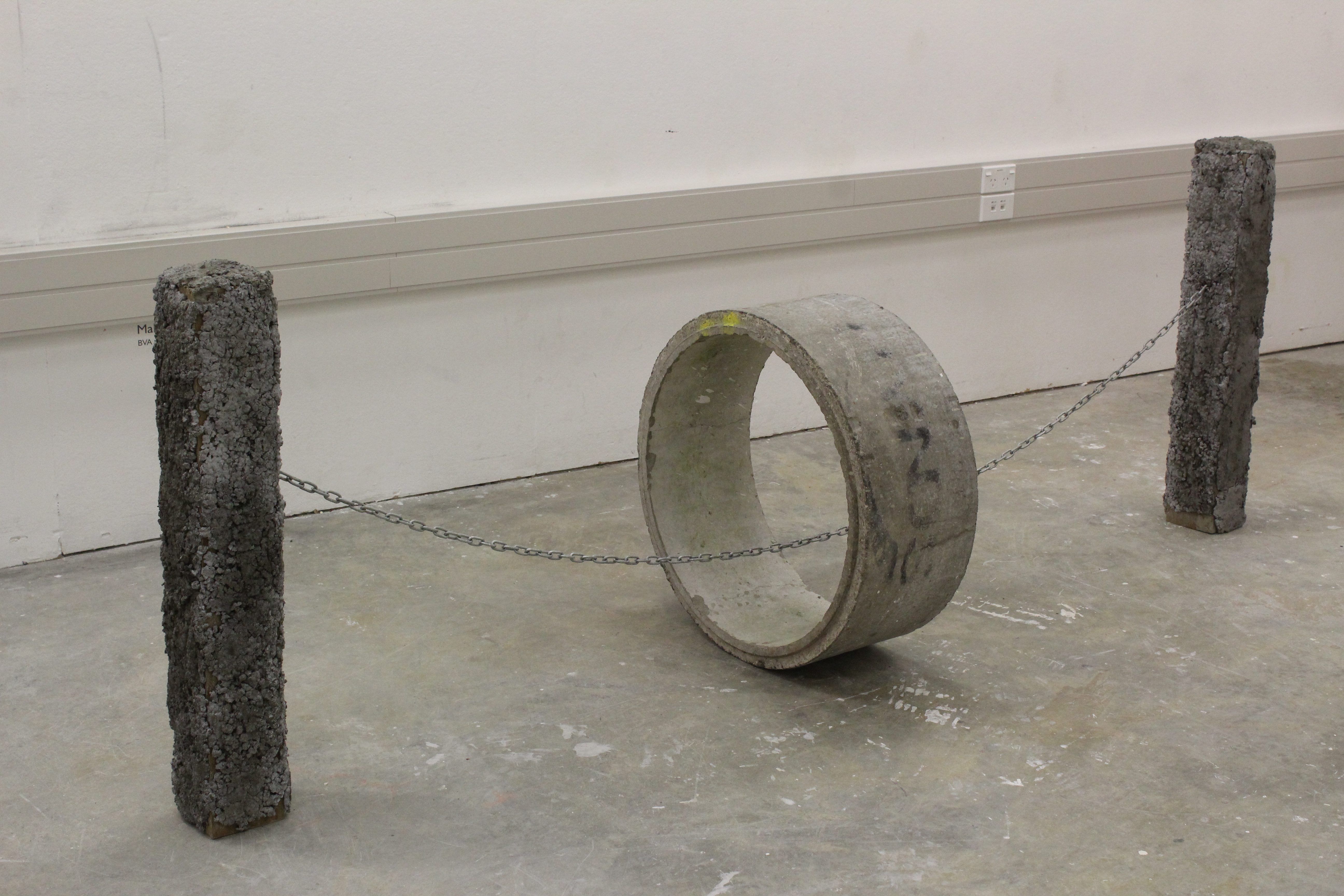
Within the installation Im Rad verloren, the notion of balance is explored in both a physical and metaphysical sense. The weight of two objects suspends the third in perfect balance. Voided of movement. The symmetrical nature in the never ending cycle of the wheel. Spinning in eternity. The perpetual motion in sound with vision. All of which encompassing the enigma of the snake consuming its own tail. The Ouroboros. A paradox in which an infinite cycle becomes all as one. How within eternal infinity, the idea of fullness is as good as empty. How, if something were to possess all qualities, it would therefore possess none. The point in which an unstoppable force meets an immovable object.
Predominantly working with found materials, the objects birth their own form and shape. Forgetten, abandoned, and broken. These incongruous elements seek to find monogamy with one another, with no item less important than the next. The skeletal foundations acting as a linear game of Jenga. If the left element is absent, the foundations fall to the right. If the right, then vice versa. If both are to be absent, the foundations fall in of itself. Basic architectural principles which have taken inspiration from such artists as Paul Cullen. Pushing the boundaries of balance among what he described as tormented objects. Or Lee Sisan, who seeks to maintain balance with between man-made beings and nature. Where they may co-exist.
Im Rad verloren strives to address the issues that balance has in almost any applicable sense of the word. Balance feels like a wheel. A wheel which forever spins the same direction, at the same pace, in the same place. Its determined, stagnant, and finite within its nature, with no room for fluctuation nor variation. Balance is set in stone. There is no greater fear than to remain static in the same routine. To be stuck in the wheel is likened to an impending downward spiral. Inevitability.
Located predominantly in the realm of three dimensional digital modelling, while also incorporating animation and audio augmentation, my practice engages concepts drawn from metaphysics. These metaphysical ideas fall in between the boundaries of the pleroma in Gnosticism, and the ouroboros in alchemy. Expressing the enigma of the snake consuming its own tail, the ouroboros is a paradox that interests me: How an infinite cycle becomes all as one. How within eternal infinity, the idea of fullness is as good as empty. How, if something were to possess all qualities, it would therefore possess none.
 Finn Olsen-Hennessy