Joesph Beuys
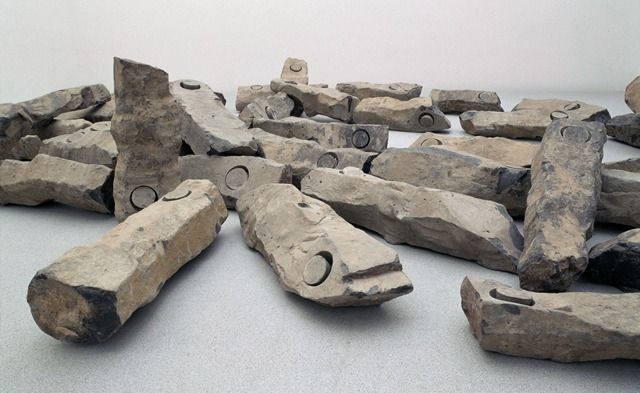

Joesph Beuys, a German performance and sculptural artist, prominent within the art community for spearheading the Fluxus Art Movement within later 20th century. Fluxus was an artistic term alluding to the art form of creating from ‘at hand’ materials, encouraging collaboration and performance based works. Not set format. The attitude of ‘anything goes’ was the foundations of Fluxus. An attitude which was more than clear throughout his body of works. From spending three days in a cage with a live coyote in I Like America and America Likes Me (Joesph Beuys, 1974), to the found material of Pflasterstein/Paving Stone (Joesph Beuys, 1975) , the embrace of this notion with Fluxus is liberating.
Focusing on incorporating philosophical ideas and humanist message through what he called ‘Social Sculpture’, he saw art as a vehicle for psychic healing, social transformation and to gain deeper understandings and awareness for the nature around us. The End of the Twentieth Century (Joesph Beuys, 1985) is a collection of 31 individual basalt rocks objects, each to a mammoth scale. With no set in stone arrangement for the sculptural piece, the purpose of the work was to create a congruous relationship between what he called “the old world, on which I press the stamp of the new world” (Lucy Watling, 2014. Quoted in Willisch and Heimberg 2007, p.7.). With a passion for retaining the integrity of ecology, this work is the manifestation of what Beuys may see has the impending fate of the near future.
Paul Cullen
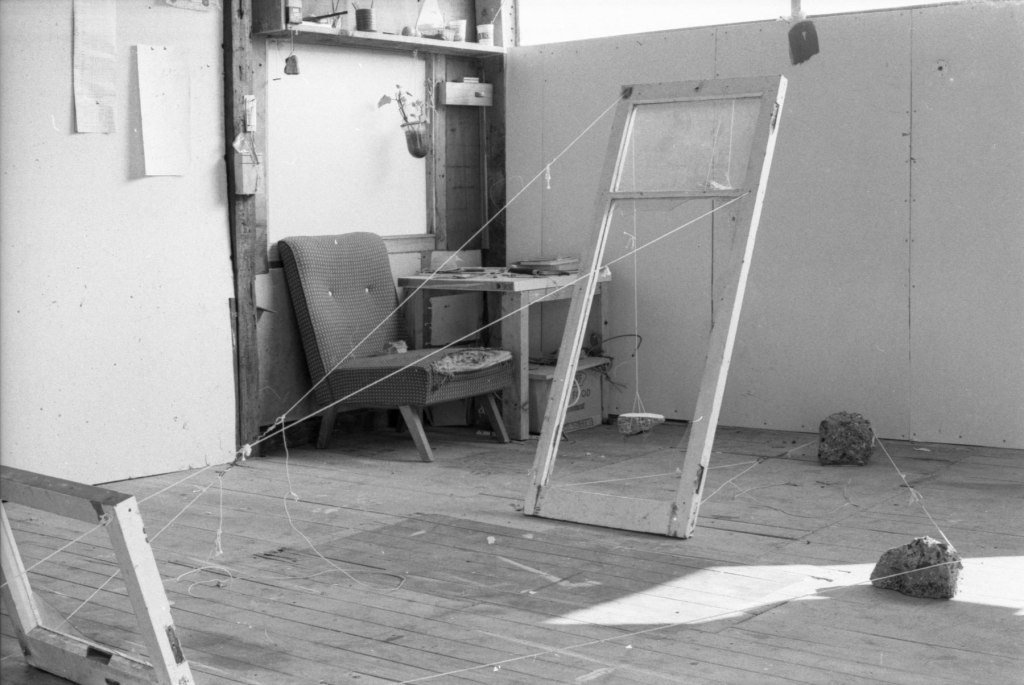
The late New Zealand artist Paul Cullen has had huge impact on direction and framing through individual practice. With an expertise within architecture, furniture, and landscape installation, there is a clear correlation which has been applied to his sculptural works. Exploring antipodes such as visible and invisible, stable and unstable, he framed these opposites into working with dismantled and tormented objects. These objects varying from chairs, tables, pencils, to door frames. Annoyed with the lack of immediacy of metal, Paul Cullen preferred using wood and epoxy resin within a lot of his sculptural works.
In the work Untitled (Paul Cullen, 1975), Paul teases the notions of balance and how far it can be pushed. Using nothing but found materials and string to hoist each object to one another at particular angles. All inter connected and intertwined with each other. If one object is shifted or removed from the sequence, the rest will fail to remain. Idea of borderline potential movement is fascinating within majority of his work. With architectural elements predominant through this work, its likened to a skeletal structure in which the skin and flesh is removed.
Jose Dávila
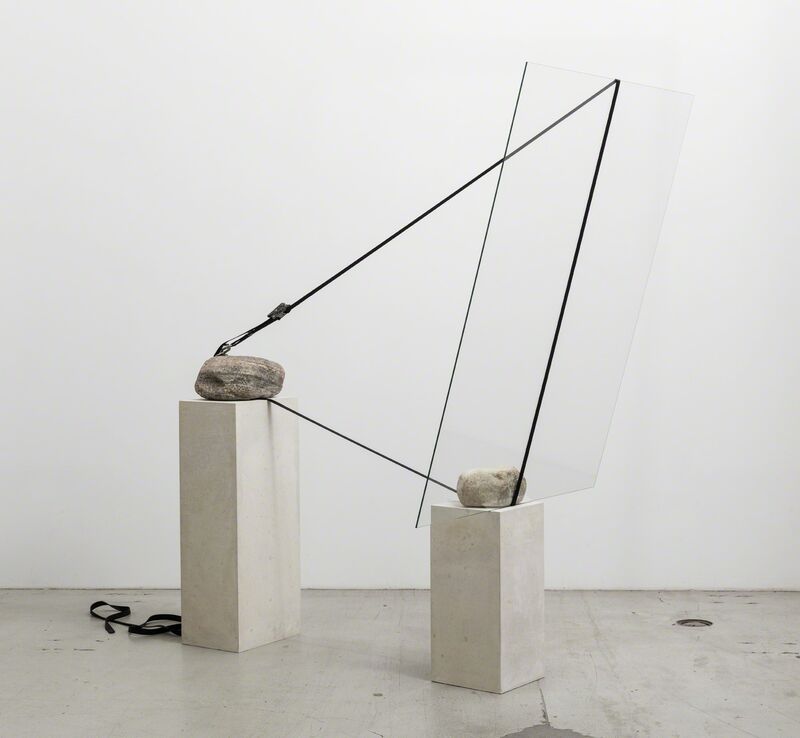

Mexican Born artist Jose Dávila is an artist who’s primary medium falls into the realm of sculpture. Drawing on his training as an architect, he incorporates this knowledge, applying it towards the assemblage of various structural forms. Through concrete, stone, glass and various other materials, his focus “reflects on the failure of utopian, modernist architectural principles” (Artsy, n.d.). In a modern society where buildings are voided of care, demolished or poorly remodelled, Jose Dávila explores these concepts through a variety of sculptural pieces. The robustness of concrete and stone paired with fragile assemblage leaves a sense of venerability, where a shift of any component may threaten the integrity of the work.
In such works like Fundamental Concern XXVIII (Jose Dávila, 2019) and Joint Effort (Jose Dávila, 2015), the oxymoron of fragile-esk assemblage and the heavy permanence of the objects are intriguing. The sculptural works rely on balance, tension and intricate placement. However a sense of disturbance within arrangement and assemblage seems prominent. A disturbance which could be called “poetic in failure and in our limitations” (Artsy, n.d.) as quoted by Jose Dávila himself. Coming to terms with the poetically failed nature of architectural principles, accepting and acknowledging them the imperfections of structural arrangements and assemblage become something of beauty.
Isa Genzken
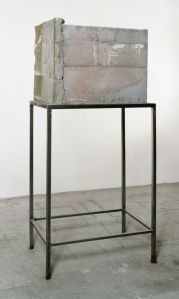
Constructivism. Minimalism. Punk culture. Mordernist architecture. These are the primary focuses within the practice of German artist Isa Genzken. Most eminent within her sculptural works is that of Constructivism. An offshoot of abstract art, especially within sculptural, her three dimensional works consisting of concrete and plaster casts have clear correlations and connects to that of early to mid 20th century architecture. Especially in areas like Russia. The reasoning of these connections were to make a critique on capitalism and “explore humanities fraught relationship with the built environment” (Artsy, n.d.).
Although also known for her assemblages of found objects like potted plants, shipping crates and such, Saal 2 (Isa Genzken, 1987) is among one of many concrete/plaster casts, this being her primary medium. Within majority of these casts and specially within Saal 2 (Isa Genzken, 1987), exposed gravel erodes to the surface of the concrete cast, accompanied by chipped edges and surface discolouration. These casts are then placed upon welded iron stands, acting as a form of pedestal of sorts. What could be called imperfections become organic and leave geological impressions upon the sculptural works. Commenting on the “foundations of human construction” (Kirby Gookin, n.d.) through architectural composition.
Ana Holck
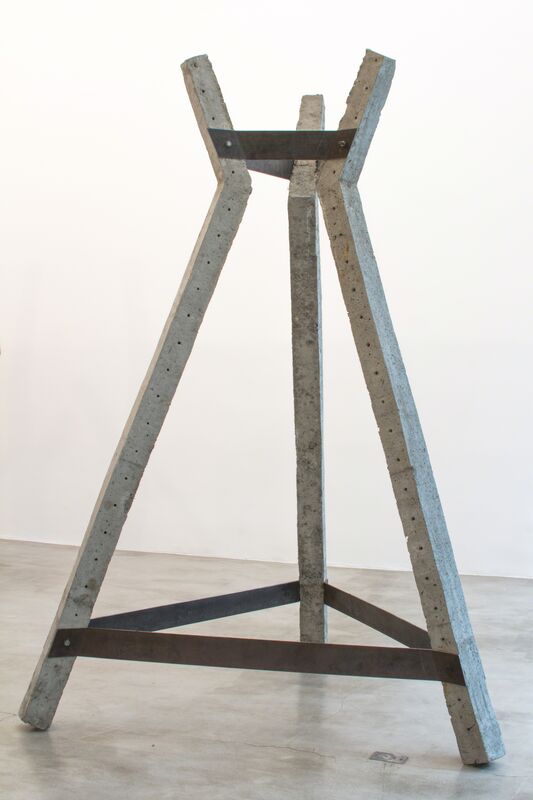
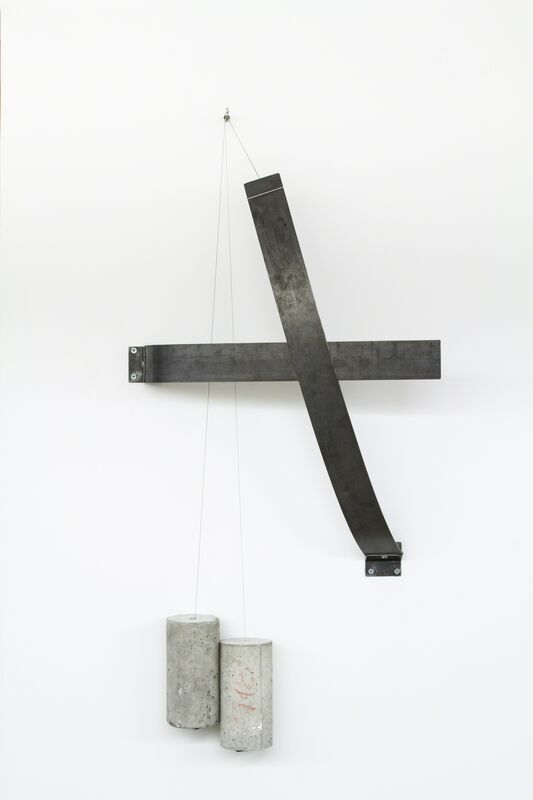
Ana Holck is a Brazilian born artist, who’s work is a direct response to her knowledge of architecture and urban planning. A field in which he father specialised in, as a structural engineer. Seeking to deconstruct her understanding and learning of architecture she says her “relationship with with architecture was conflictive” (Artsy, n.d.). To abrupt the traditionally conformities of architecture and engineering is what Ana sets out to accomplish through her sculptural artworks. Most of which include materials such as brick, plexiglass, concrete and vinyl adhesive tape.
Within Torre III/Tower III (Ana Holck, 2012), architectural elements have been applied within an avant-garde lens. Casting a steel structure with concrete to create a tower-like, skeletal anatomy. Leaving food for though as to whether it is the unfinished foundations of something more, or the deconstruction of something which once was. Cruzamento III/Crossing III (Ana Holck, 2012) follows similar principles, however incorporating the properties of suspension, balance and tension. Almost as an evolution to the previous work, in her quest to deconstruct her prior knowledge of traditional architecture. Her body of work is best describe as “sculptures that foil natural understanding of perspective and space” (Artsy, n.d.).
Nam June Paik

Alike to Joseph Beuys, Nam June Paik played a monumental role within the experimental art movement of Fluxus. The South Korea artist has been widely regarded as the father of Video Art, within the art community, across the globe. Spearheading the movement along with the likes of Andy Warhol, Nam June Paik saw and treated the use of televisions within sculptural works more than just a means to watch videos. He treated the televisions as sculptural objects themselves. Specialising within video and music, Nam June Paik would often distorted imagery among these now video based sculptures. Experimenting with alternative ways of perceiving video/film from the conventional.
Within the work Video Chandelier X (Nam June Paik, 1991), Nam displays a multitude of eleven monitors attached to the ceiling in the form of a chandelier. Shrubbery and bush envelopes the small monitors exposing areas of the screens while simultaneously hiding cables and cords from within. From the birth of video art within the early 60s, Nam saw this as a window of opportunity to allow humans, technology and nature work in tandem with one another. Optimism for a future of harmony between the three. A future in which technology was eminent to evolve, with or without the likes of humans and nature. The placement and arrangement of the monitors is also of interesting, striving for a unique observation platform as such to view art. From above.
Justin Matherly
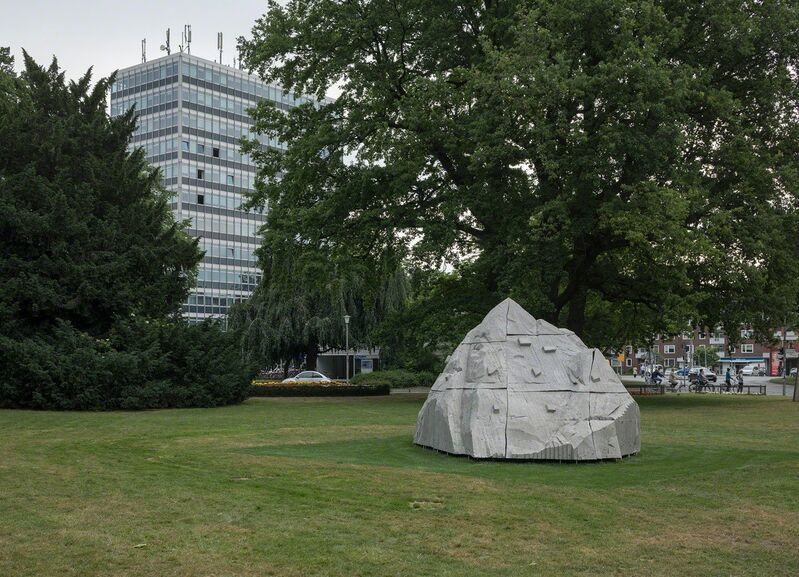
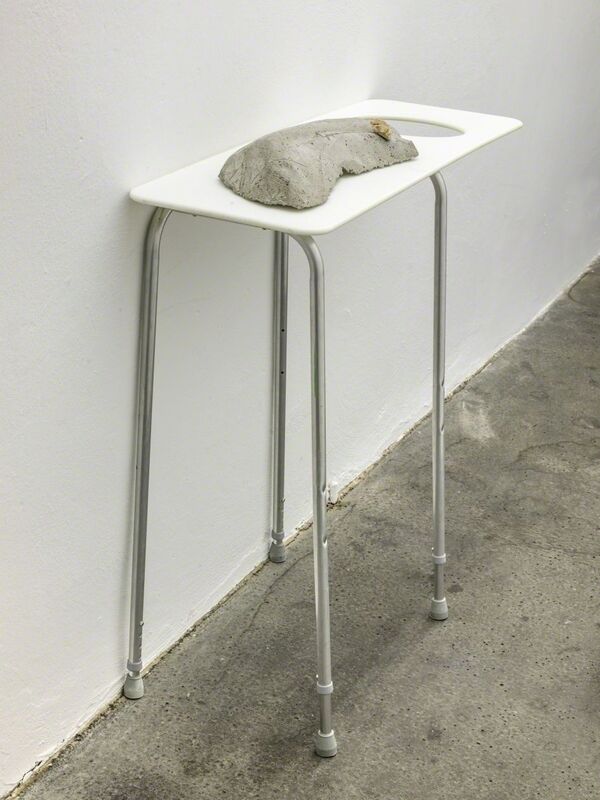
American born artist Justin Matherly practices in both paintings and sculptures, focusing a lot of his concepts surrounding each work from Greek, Roman, and Philosophical literature. The medium for his sculptural works primarily are revolved around concrete, medical equipment, crutches, and chairs. All of which in a usual rotation of use. Predominantly applying these materials to create larger than life scaled sculptures. Mixing the past with the present, the old with the new, and the ancient with the modern, his work follows some variations of architectural and constructivist geometrical structures.
Within one of his more famous sculptural pieces, Nietzsche’s Rock (Justin Matherly, 2017) is a large scale monument based in Münster, Germany. The sculptural work is a manifestation of sorts of a concept created by Nietzsche back in the 19th century, referring a rock as a symbol for the eternal reoccurrence of life. The eternal repetition of life is likened to an hourglass being turned over and over again. If such idea is true, then even the most trivial of actions hold tremendous weight. Justin creates this rock, however he places the monument upon supports to symbolise the “weakness and the loss of mobility and independence” (Sophia Trollmann, n.d.). Other works also follow this pattern of alluding to philosophical ideas and authors. Another being that of Coldeness and cruelty (Justin Matherly, 2015), a work in which was named after a book by Giles Deleuze, Masochism: Coldness and Cruelty (Giles Deleuze, 1967).
Lance Pearce
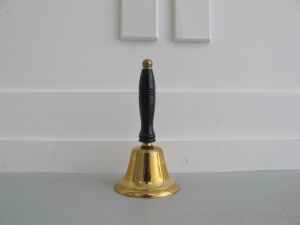
While You’re On Your Way (Lance Pearce, 2019) is a conceptual artwork created by New Zealand artist Lance Pearce. The focus of the work isn’t about the bell, but rather the meaning behind the work as a whole. The purpose of the work is to address the numerous possibilities behind the titles given to artworks, as well as the role they place with one another. The title and work aren’t separate from one another. They are extensions of each other. As stated by the artist “a title inevitably establishes filters and seeds trajectories for feeling and thinking in response to a work of art” (Lance Pearce, 2019). The title changes the view in which the observer perceives the work. The title can work in a multitude of ways. Being; descriptive, playful, elusive, essential, unreliable, or even no more than a label. The absence of titles can even speak louder volumes than with one, acting as a rebellion of norms or voluntary silence. This work is more so an educational piece in some regards. Opening new doors for artists to explore when thinking about their work.
Lee Sisan
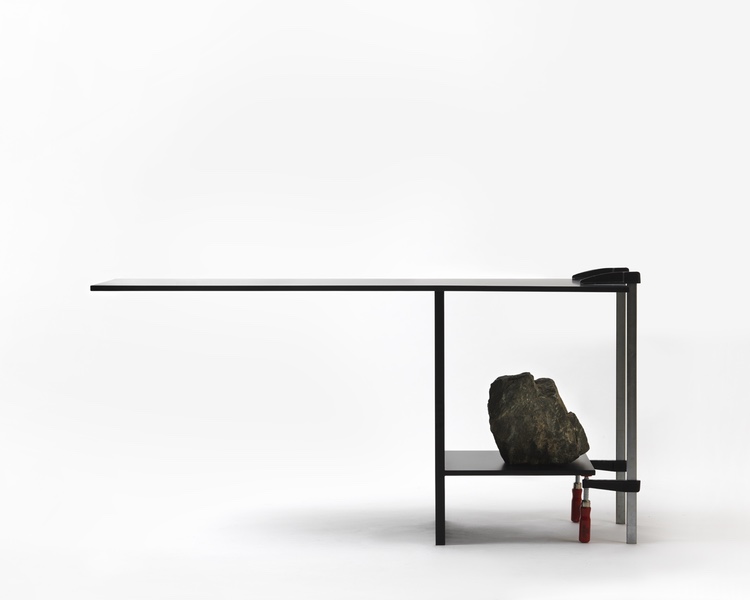
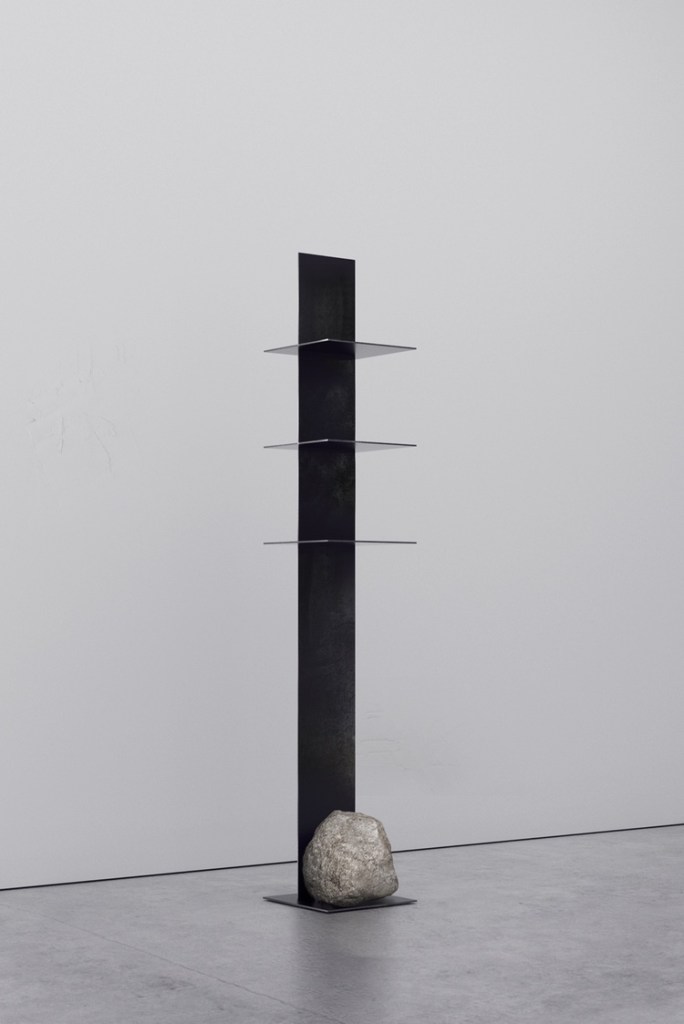
Lee Sisan is a South Korean designer and sculptor who predominantly works with metal structures and natural rocks. The interconnection between these materials of minerals and man-made structures reflects upon what he calls, “the relationship between nature, artefact and humans” (Lee Sisan, n.d.). Although majority of his work revolves around interior design and furniture, each individual piece is beautifully composed and arranged, with awareness of mixing aesthetic and practical use. The predominant materials of steel and natural stone may seem incongruous with one another, however, Lee Sisan seeks to find harmony behind the pairing .
In the 2019 work Balance (Lee Sisan, 2019), the sculptural piece which resembles that of a coffee table focuses on the idea of balance. Lee allows the natural stone, iron plate and clamp to co-exist with one another, but not without a single element. Each material serves there own specific role in keeping its structure. Codependency is essential for them to co-exist. This draws on Lee Sisan’s purpose of conducting “experiments in which man-made beings co-exist in harmony with nature and maintain balance” (Lee Sisan, 2019). Jangseung (Lee Sisan, 2021) symbolises that of a traditional Korean totem. Jangseung’s acted as deities placed on the boundaries of villages in order to frightened away demons. The structural form of this work reflects this directly, with the natural stone taking the form of the Jangseung.
Kurt Steger
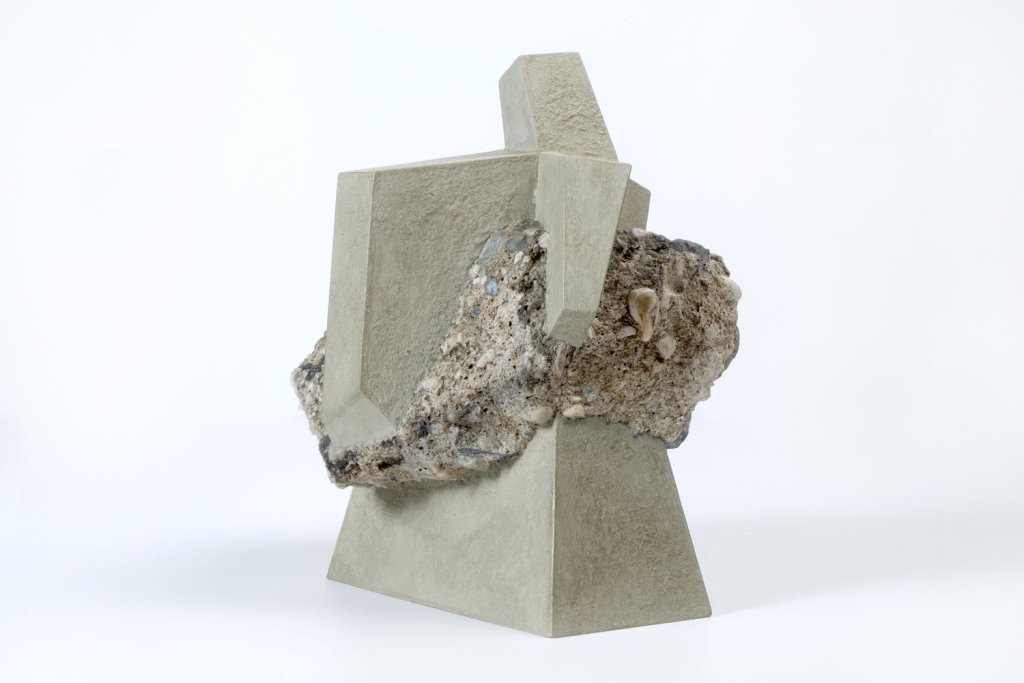
The American born Kurt Steger’s sculptural series Urban Structures (Kurt Steger, 2015) includes 37 individual sculptures made up on natural rock, stone, granite mixed with a variety of man-made structures such as wood, paper, paint etc. His purpose in creating these sculptural forms is to speak on the “loss of connection to indigenous cultures and the ways this loss affects the human psyche” (Steger Sculpture, 2015). Kurt Steger acknowledges this connection loss and seeks to form harmony upon opposites, making them monogamous among one another. He offers a chance for healing in a world where culture is lost and gentrification is present. A world where construction takes priority over our ecology. All of which is happening at extremely rapid paces. He doesn’t seek to destroy that of what has been built, but seeks for the man-made structures to work in tandem with our various indigenous cultures and their ecologies all over the globe. To find the harmony among the chaos.
 Finn Olsen-Hennessy