Starting Off
At the beginning of the year, I decided to start where I ended the previous year. That being working with the software Blender, and creating three-dimensional animations with it. I was intrigued by mirrors and reflections. Through this, I replicated reflective surfaces in Blender to surround moving objects. Within this particular animation, a sphere is hollowed out with its verticle points remaining present. Illuminating the surrounding rotating surfaces which are emulating that mirrored texture. The start of distortion light began here and was the top of the spiral that entered me into my fascination with the natural qualities of light. I had also decided to replicate an older video-based work of mine and reimagine it within the realm of working in reflection and distortion. The spiralling nature of the animation was hypnotic in some sense, as the animation was formed for it to loop over and over again. It allowed this never-ending cycle to occur. In which the question is posed as to if each cycle is the exact same or if changes are occurring. There is constantly a new aspect to notice and focus on for prolonged amounts of time.
Experimenting With Light
Following the first experimentation, I dived into creating a multitude of other Blender animations that had a lot more depth involved with the geometry and the reflections. I saw the potential to replicate the night sky through trial and error. The constant manipulation of the UV sphere allowed for a celestial-like array of lights, reminiscent of that of a starry night. I made it rotate in a constant motion and made the shape swell up and down as it did so. Its mesmerising quality and almost hypnotic nature began a domino effect to occur within my practice. As much as I enjoyed this adaptation from the previous animations that I had been making, there was an absence of depth. The two-dimensional aesthetic that came from a three-dimensional software seemed like a waste in my eyes. So I deconstructed and reimagined the celestial body animation and made it so the reflective aspect was more relevant in the work. Exhibiting the natural qualities of light through unfathomed impossibilities. As the shape rotates on its centre axis, it shimmers in the most beautiful way. Creating mesmerising formations, where each frame could be screenshotted and used as individual images. A sense of the spiritual begins to shine through it these works, which takes a turn in my practice as I begin to study alchemy and mysticism.
Talk Week
For talk week I wanted to present an animation that I was extremely proud of and encapsulated all my thoughts up until this moment of the year. I studied mid-century artworks on alchemy and found it to be the most profound and bizarre body of works. The images by Robert Fudd illustration the seven days of creation become huge inspiration and I want that spirituality to become prevalent in the work. Not in a literal way by more so aesthetically. I found that throughout realising my practice within the past three years, it has worked best for myself to create first and foremost, then worry about the understanding behind the work (In-depth). This is were like I fell short with the Talk Week that occurred in the middle of the year. Upon creating this animation. I has spent enough time with it to formulate an understanding. In which I had a plentiful amount of questions that I wasn’t expecting and remarks/comments that I couldn’t wrap my head around. Some questions involved that of if my work was about capitalism. Others were if it was about psychedelics. More about religion, through which one believed it to be was a cynical take on Christianity. None of the above were at all purposefully intending to portray these notions. However, I found it an extremely great takeaway to make sure no holes are left open in either the explanation of the work or the physical interpretation of the work (Unless intended).
First Contextual Statment
The contextual statement from the mid-year assessment which aided in formulating an understanding of how I personally perceived my work to be represented:
“I have noticed how light travels in my bedroom throughout the day. I know what time the shadow cast from my chair will reach the adjacent wall. I know what objects reflect the afternoon sun, distorting projections onto my bed. I know that under my desk when it is night, the only visible sight is that of a soft orange glow from the billboard light outside my window. It never changes. It is always and forever will be the same. Easy to forget about its existence, but it can’t go unnoticed once made aware of. Like our nose between our eyes. How often we blink. Our breath. Light seems to act in the same manner. Likened to a wheel. There is no course for deviation at their base value. It is perfection in essence. To be able to play with this idea of perfection, distort it, manipulate it, bend it to my choosing. Deconstruct it, reconstruct it, then deconstruct it again. I see it not as a means to question perfection and its legitimacy. But to showcase the possibilities of anti-matter. I see the possibilities for a monogamous relationship between the physical material and the anti-matter – the light. A relationship that does not base its existence on what is seen, but what also is not. The shadows. Everything the light does not reach. Questioning where in fact the “empty” space is incorporated.
Through the anti-matter’s adopted form of a wheel rotating on its axis, this idea of a never ending cycle is present. Sometimes there is more than one cycle occurring at the same time. They move at different speeds, and have full revolutions at different times. It is a constant juggle for perfection within the presumed chaos. However the calming nature of it comes from the fact that we know where the light is headed, and we know where it is returning. That’s the beauty of the wheel. That is why it is perfect. That even in the darkest of moments, when reality seems distorted, when all seems bent and turned upside down, when all light seems lost… to find comfort in its absence is to expect its return. Sooner or later.”
End Of A Run
The final animation I made was in a similar format as the other ones previous. It was a challenge to myself to test whether I saw much of a worthwhile end result in the way I was developing my practice. I decided to reconstruct the same animation that I created for Talk Week and create somewhat of a mandala effect through mirroring the shape on both the x and y axis. I felt at this point I had reached a limit where I could achieve all that I wanted with such perimeters and couldn’t push the boat out any further. The very foundations of the natural capabilities of light we present, however, lost in the awe of the hypnotic, morphing and swelling three-dimensional shapes.
CRT TV
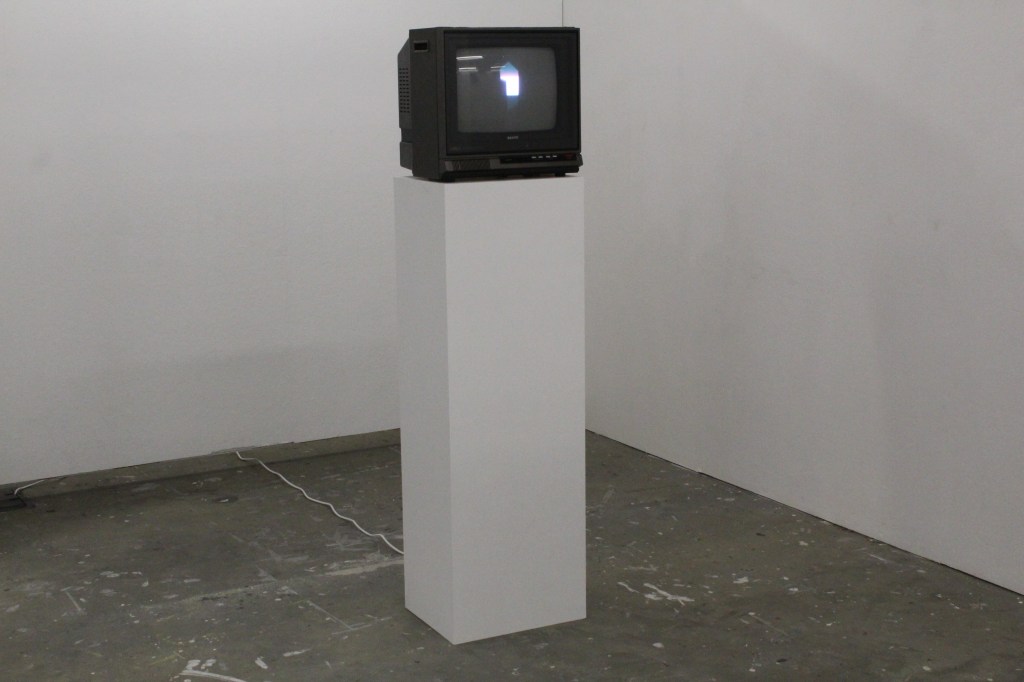
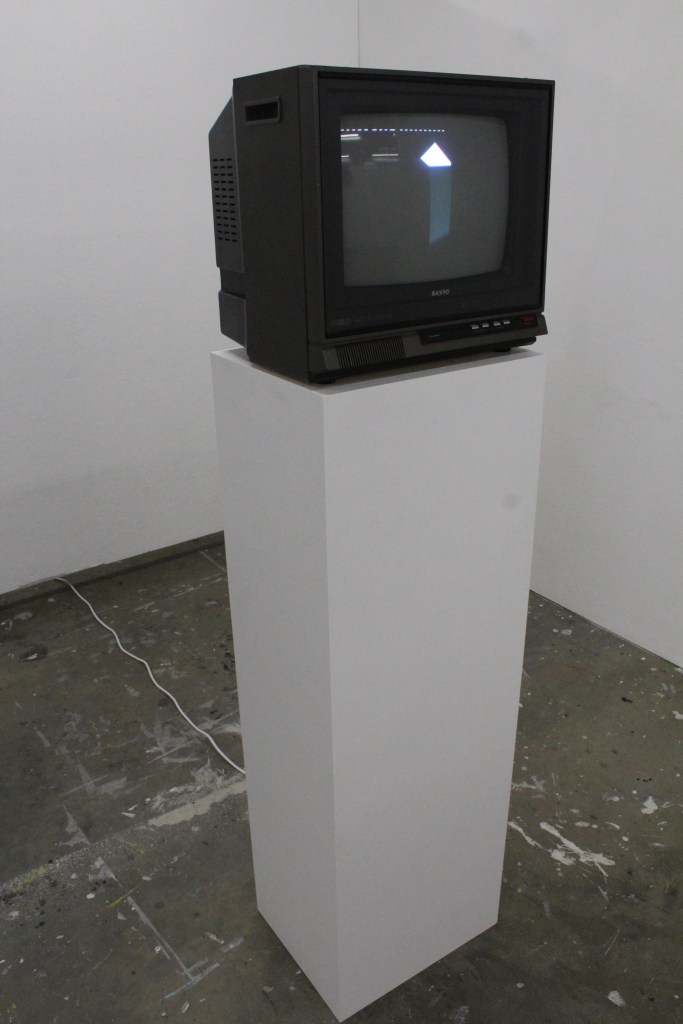
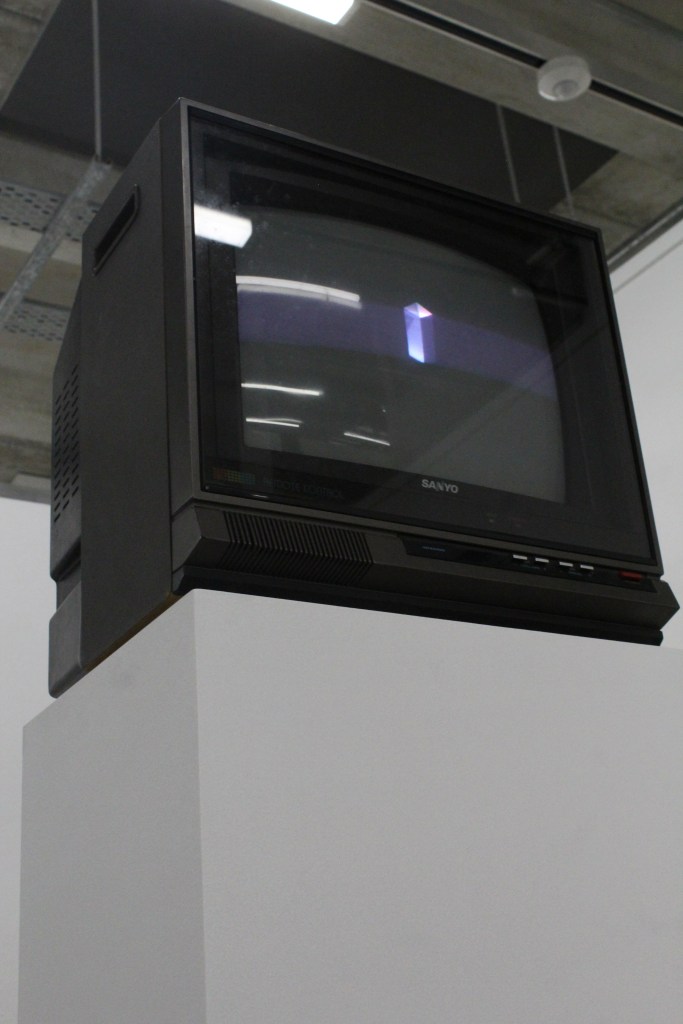
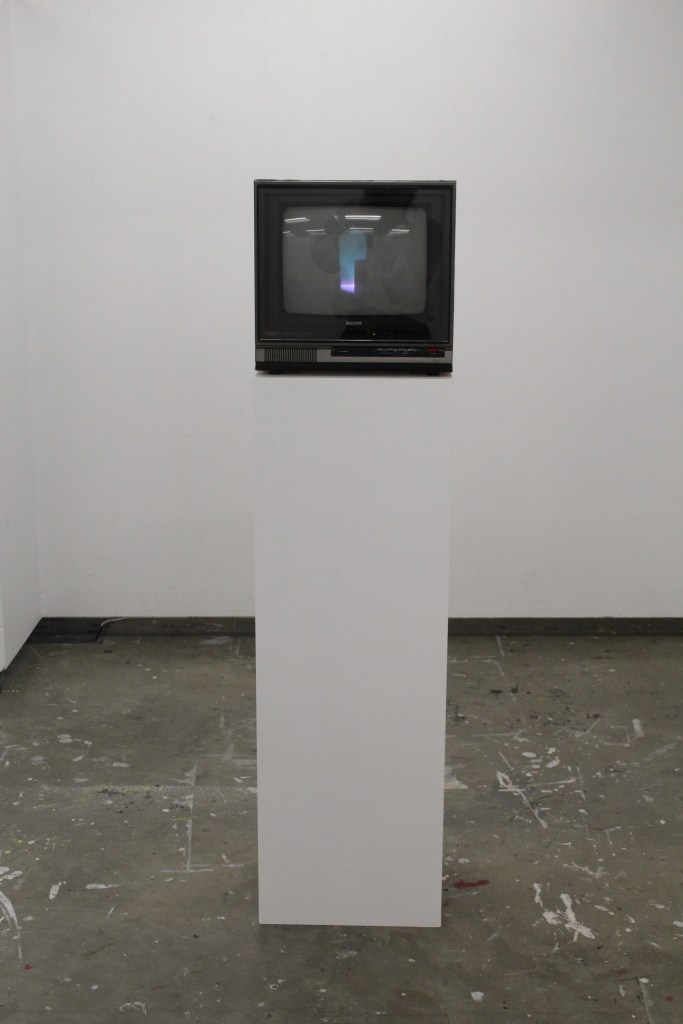
Out of pure curiosity I wanted to test out how animations would be suited on retro CRT TV’s. I reverted back to the basics of manipulating light on reflective surfaces through movement. I created a very simple geometrical shape of an obelisk and worked on the surface texture so that it would be extremely reflective of its surroundings (If light emission is present in any way). I created a dome that emitted a white light, surrounding the monolithic shape. As I animate the object to rotate, it reflects the emitting light in the void-like surroundings. The light warps and distorts along its geometry. A series of different camera angles of the same object present the distortion in different ways. The continual rotation of the obelisk creates a sense of sound which isn’t there in the presence of silence. The rotating movement has a rhythmic quality that makes up for the absence. I find there personally to be a more satisfying feel to a minimalistic animation that makes ponder than that of a complicated one that does the same. And I feel that through the presentation on a CRT TV, its creates another layer to the so called “void” mentioned. A void which you could reach in with both hands and pick up the objects inside. It is also an interesting way to install work, through a CRT TV. Almost falling into the conceptual art trope devices while being paired along with a plinth. And with the plinth housing the CRT TV, it almost doesn’t seem lost or out of place, due to what is actually being presented on the video. They become monogamous with one another.
Finale
Upon realisation that the incorporation of the plinth works with the CRT TV and the video, I wanted to create a specific plinth for the CRT TV so that it comes across as one continous object. I obtained a new CRT TV and found the width, length and then chose the height I wanted it to be standing at. I wanted an average viewer eye level to be the goal, so I picked 1200mm. When making the plinth I used MDF wood and connected the sides with angle joins and strong wood PVA glue. The top of the plinth had a hole drilled in, big enough for a plug to dropped through, including a mini mouse hole drilled at the back base of the plinth for the cord to run out of. The MDF wood is known to be difficult to paint, due to its nature of surface erosion is not using the correct paints and appilcation process. I firstly sanded down the plinth and then primed it and repeated that process till the wood was smooth and free of a fuzzy surface. The video was then inverted due to difficulties of aspect ratio and the CRT TV. I don’t see it as much of a problem. I still see it follows the prominent conventions of manipulation the natural qualities of light. Overall, I’m extremely pleased with the end result, as I feel it has been able to encompass my artist aesthetic and highlight the qualities extremely clearly that I set out the find at the begining of the year.
 Finn Olsen-Hennessy