
At the beginning of this semester I made the decision to purchase Ableton Live, as it capabilities are far and through from previous DAWs I have used. Garageband and FL Studio were limiting with their software, and so the investment to purchase Ableton seemed clear. I began with taking field recordings of people speaking and made some instrumentals using various pads and synths. Upon gathering an instrumental and vocals I arranged the tracks into a fifteen second track which I then exported and loaded into Audacity. A particular favourite feature of mine is the Paul-stretch (Which is only available in Audacity), in which this effect drags out any selected audio to any chosen length, without altering the pitch. I turned my fifteen second sample into a seven and a half minute track. Creating a tranquil soundscape. From there I then duplicate the track and reversed it, in order to replicate a sense on eternity. A continuous loop.

Entering lockdown once again, I found this as an opportunity to expand my horizons and enter the realm of 3D modelling. Although there are many better alternatives to Blender, I found this software easy to use and best of all, free to use. I played around the software for a few days, creating environments and low poly objects. Not bothering on exploring animation at this point in time, I wanted to become confident with the basics. I was particularly intrigued in metaphysic, with the Ouroboros in alchemy and the Pleroma in Gnosticism. Using philosophical concepts to define reality and gain an understanding of it was my primary focus at this time. Within Gnosticism and the Pleroma, was the concept of Abraxas. A concept which can best be described as the manifestation of the Pleroma itself. It’s likened to being a God above Gods. Something beyond ‘Good’ and ‘Evil’. Representing both fullness and nothingness. In ancient scripture, Abraxas is described to have the head of a chicken, torso of a man and the legs of a snake. I saw this manifestation of the Pleroma as a challenge to experiment within Blender.
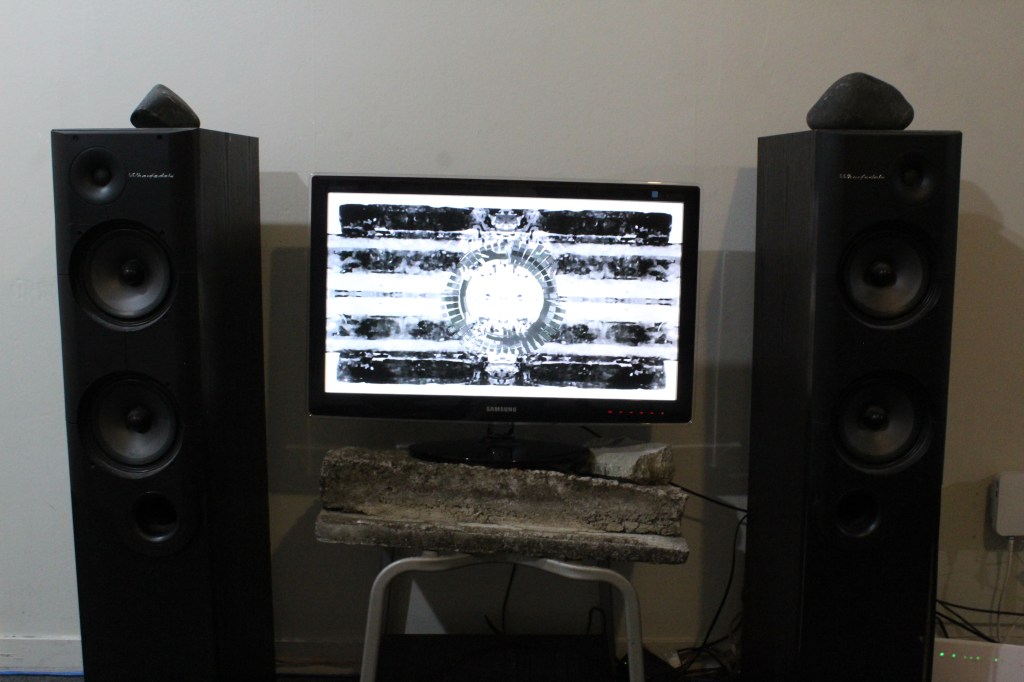
Although testing the waters with low poly objects in Blender was amusing, I felt it didn’t align with my personal practice. As an artist, I have my own personal tastes and aesthetics. If I test something genuinely have no ambition or connection then I will leave it be. I decided to begin working with animation in Blender, in experimental methods. Testing the limits to the basic mesh of Blender (Planes, UV Spheres, Cubes, Cones) I was able to create a 30 second loop of individual shapes moving and distorting in separate rooms as the camera pans from left to right. The animation itself is 30 seconds but the end and start are exactly the same, allowing for a seamless loop to occur. Still interest in metaphysics, this particular animation was a response to Ouroboros. The endless cycle of the snake eating its own tail.
Located predominantly in the realm of three dimensional digital modelling, while also incorporating animation and audio augmentation, my practice engages concepts drawn from metaphysics. These metaphysical ideas fall in between the boundaries of the pleroma in Gnosticism, and the ouroboros in alchemy. Expressing the enigma of the snake consuming its own tail, the ouroboros is a paradox that interests me: How an infinite cycle becomes all as one. How within eternal infinity, the idea of fullness is as good as empty. How, if something were to possess all qualities, it would therefore possess none.
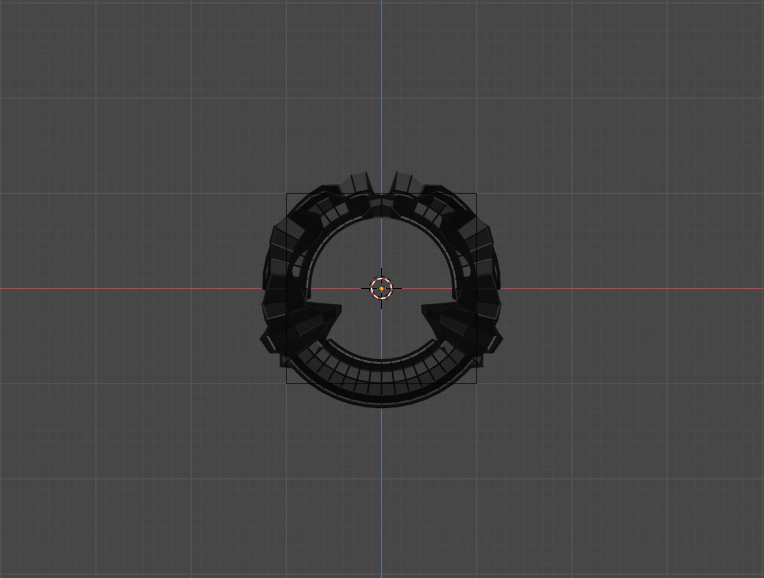
Following the Click & Collect exhibition, I was pleased with my final piece. I felt as though in encompassed my journey within Blender and sort out my initial vision. I began exploring further ideas and alternative to the 3D modelling. I recreated the wheel animation and mirrored to animation along both the x and y axis, creating an effect of symmetry. However, I began to feel that in doing so the original animation lost its integrity and was becoming void of its importance. I felt as though it become too excessive and that for the time being my exploration of Blender was put on hold. With a developed and refined animation, I was excited to explore sculptural forms and structures with applicable knowledge gained during this experience. Not a full-stop on the work, but a continuation of sorts, building on the foundations instead.
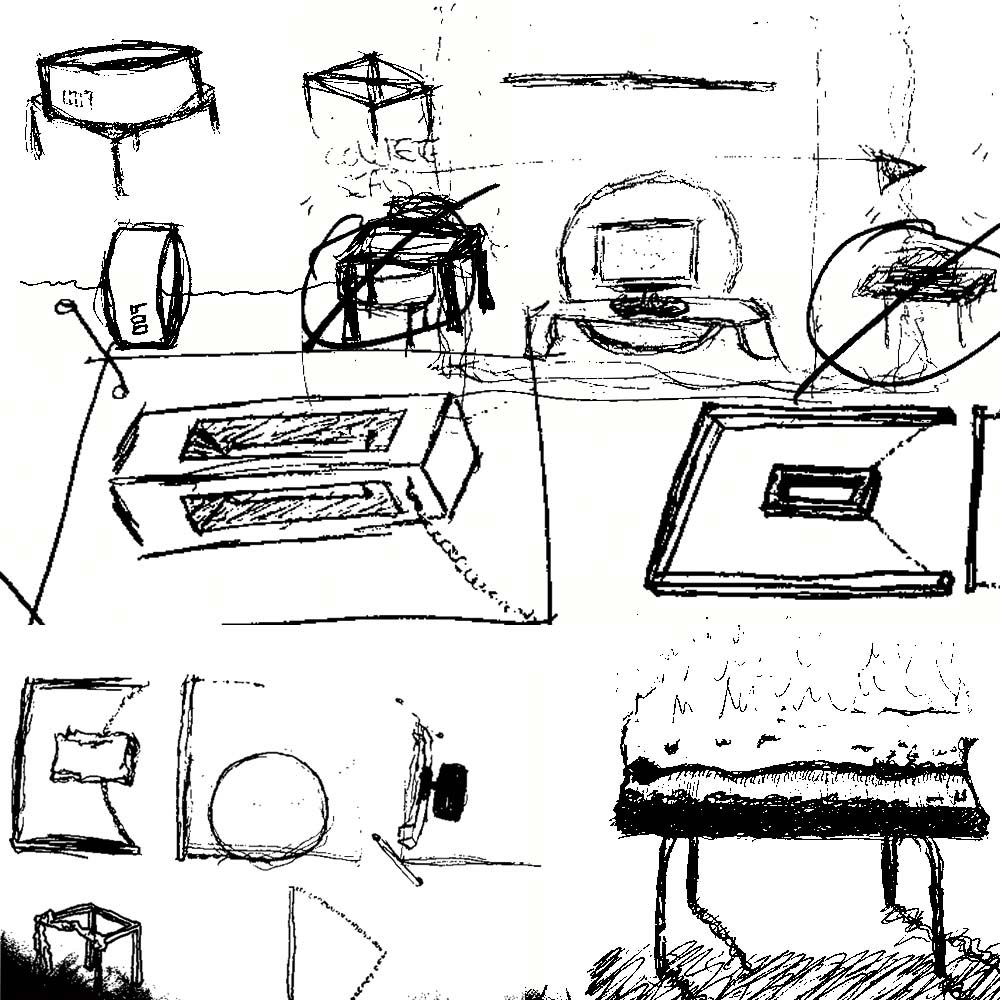
Prior to returning back to working with physical materials, I spent some time researching artists and sketching ideas which come to mind. The above image is a collage of a select few sketches I found most intriguing and had the most potential. Still focused on working among found materials, concrete and chain, a lot of the imagery became a playful experimentation with balance, weight, strength and suspension. With a old clothing rack left in my flat, I sought to dismantle and repurpose it. The idea of using the clothing as a frame to suspend objects from engrossed me and ended up becoming the foundations for the next project. Artists such as Paul Cullen, Lee Sisan and Jose Dávila inspired my mindset entering the next stages of my final project.
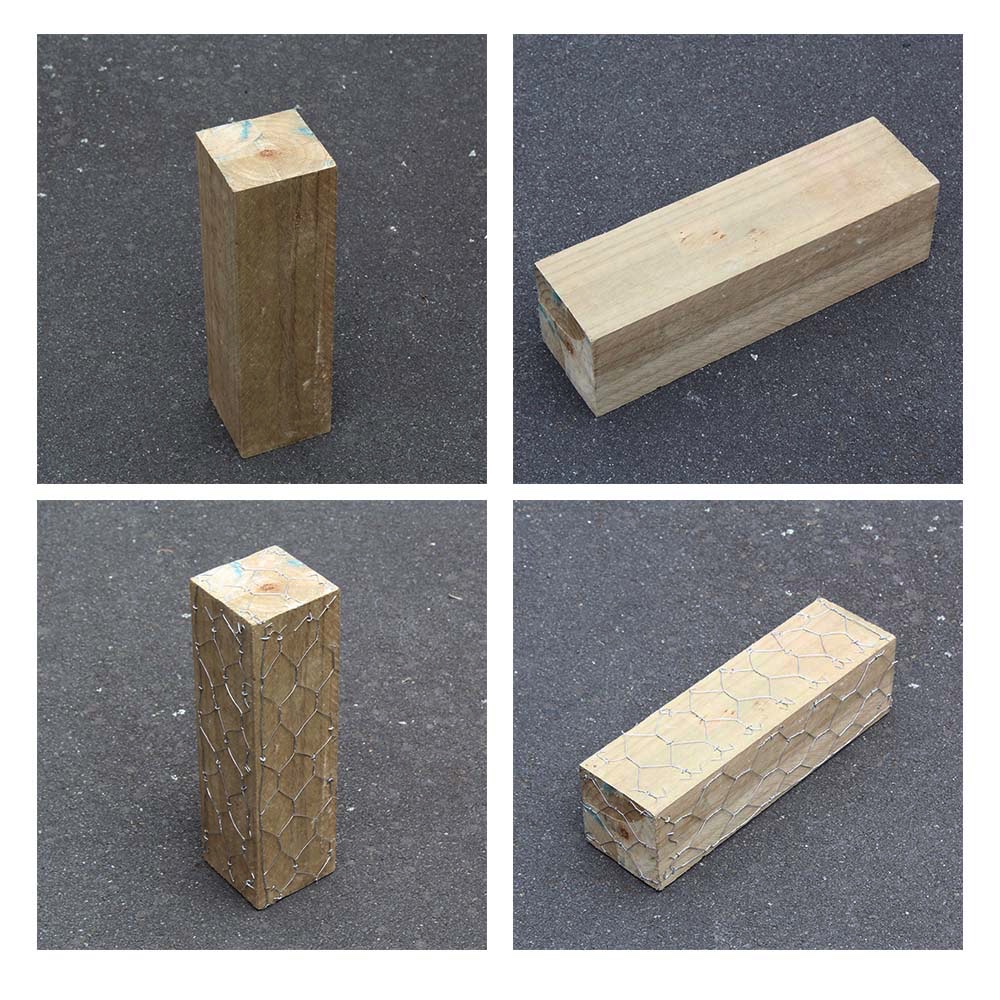
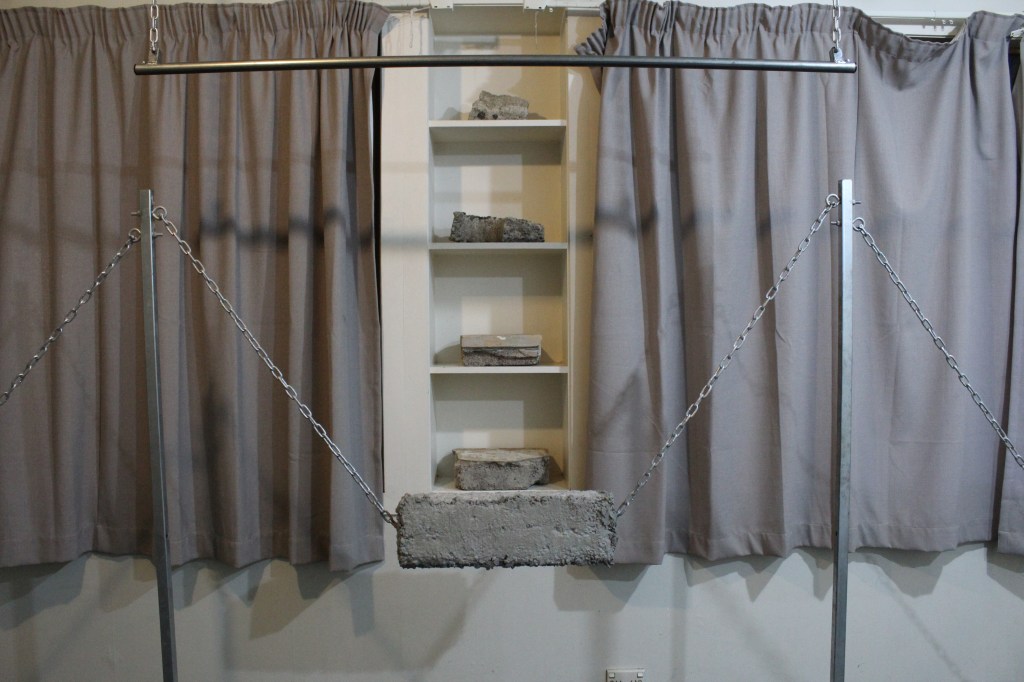
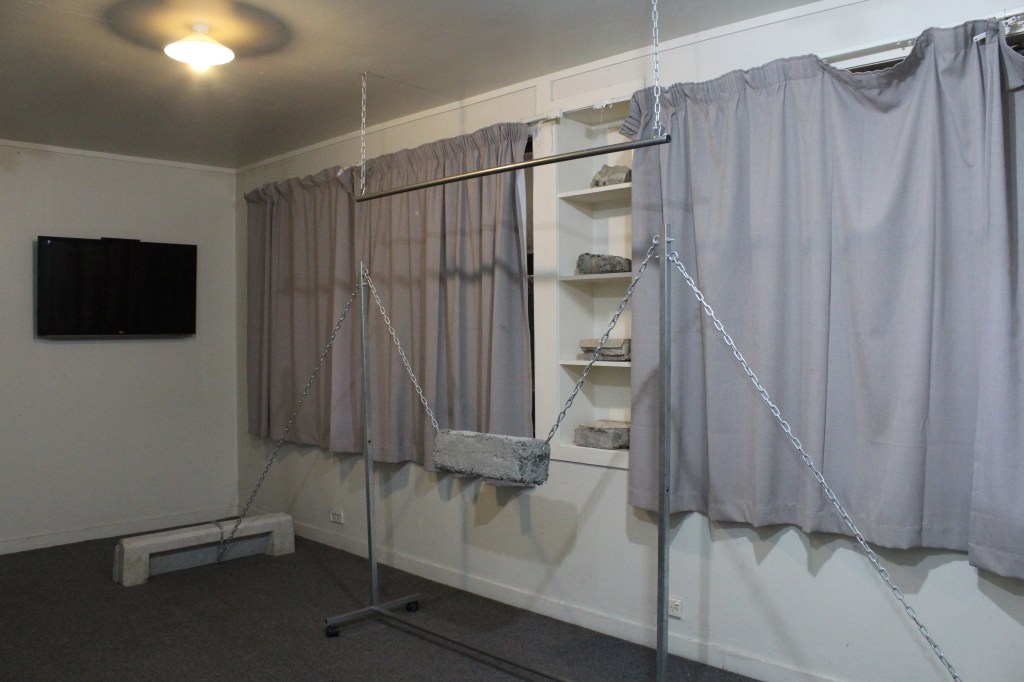
Wanting to create a suspended and cemented object between the frames of the clothing rack, I sought to redeem my mishaps from last semester when coating posts in concrete. Previously when testing this technique, I found that the surface area didn’t have enough grips for the cement to set onto. Thus upon setting, hardening and curing, the cement would rumble at even the most gentle of touches. To respond to this problem, nailing a layer of chicken wire all over the posts would aid in the setting stages of applying the cement. However before nailing the chicken wire on, the original post I purchased was too long to be suspended with the middle of the clothing. And so it was cut in half using a buzz saw. Following this process of attaching sawing and wiring, the soon to be cemented object had to connect to the frame while in its suspension somehow. I got to separate chains and drill them into the wood using a eye-bracket of sorts, upon each end of the small square faces.
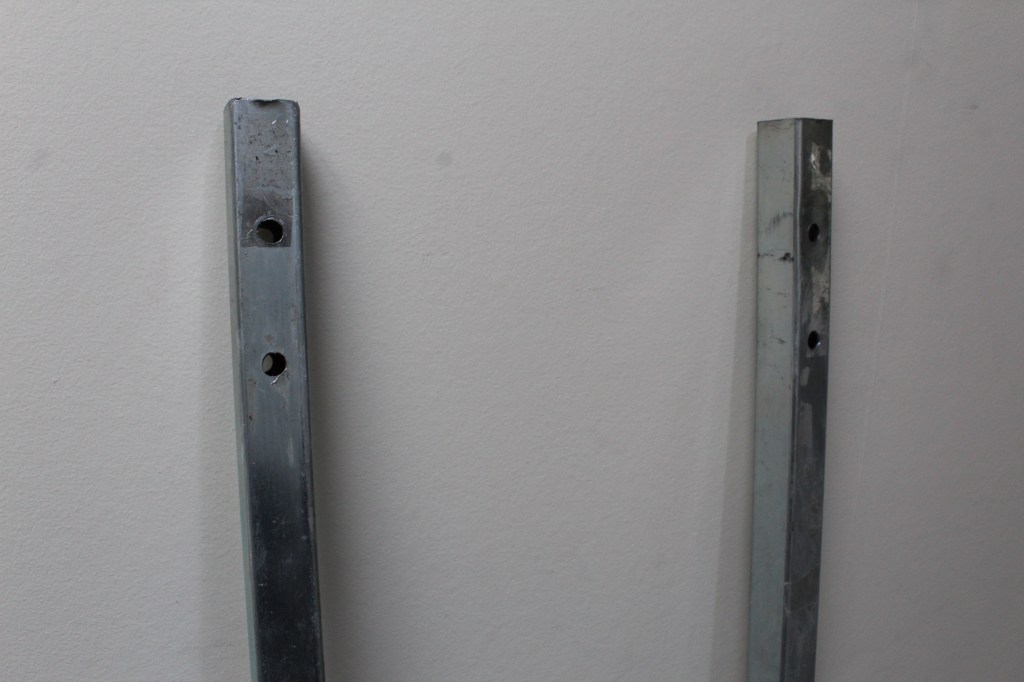
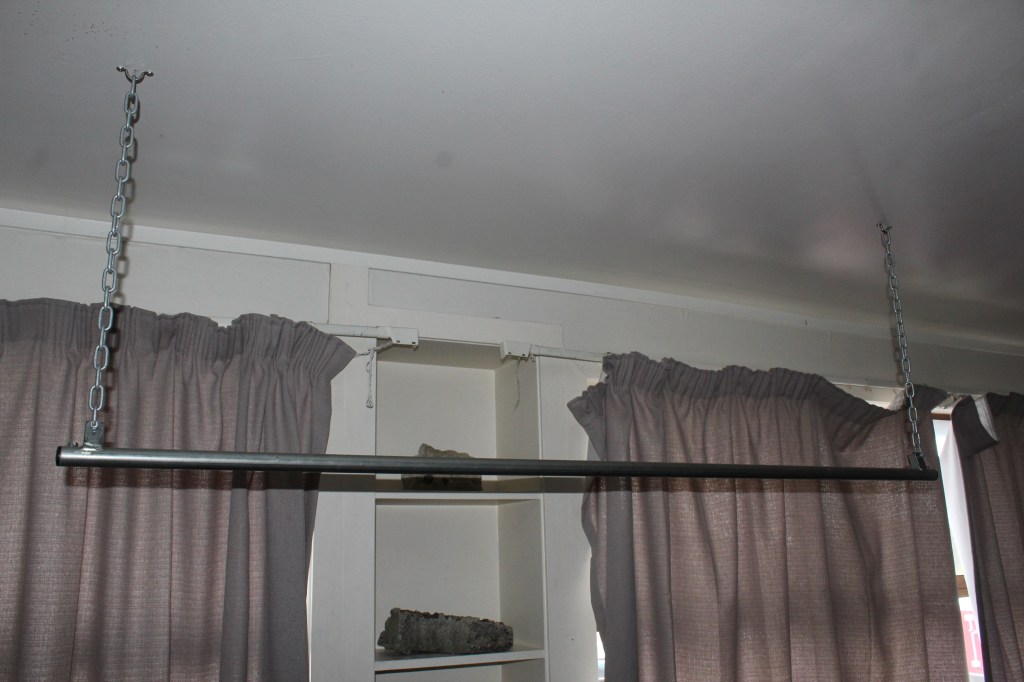
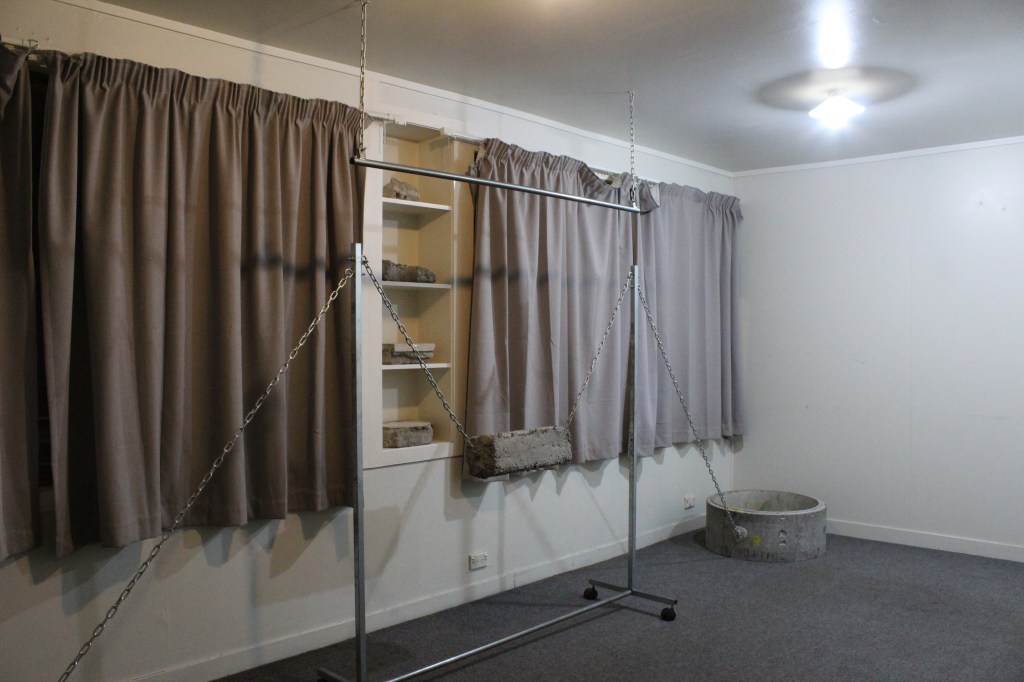
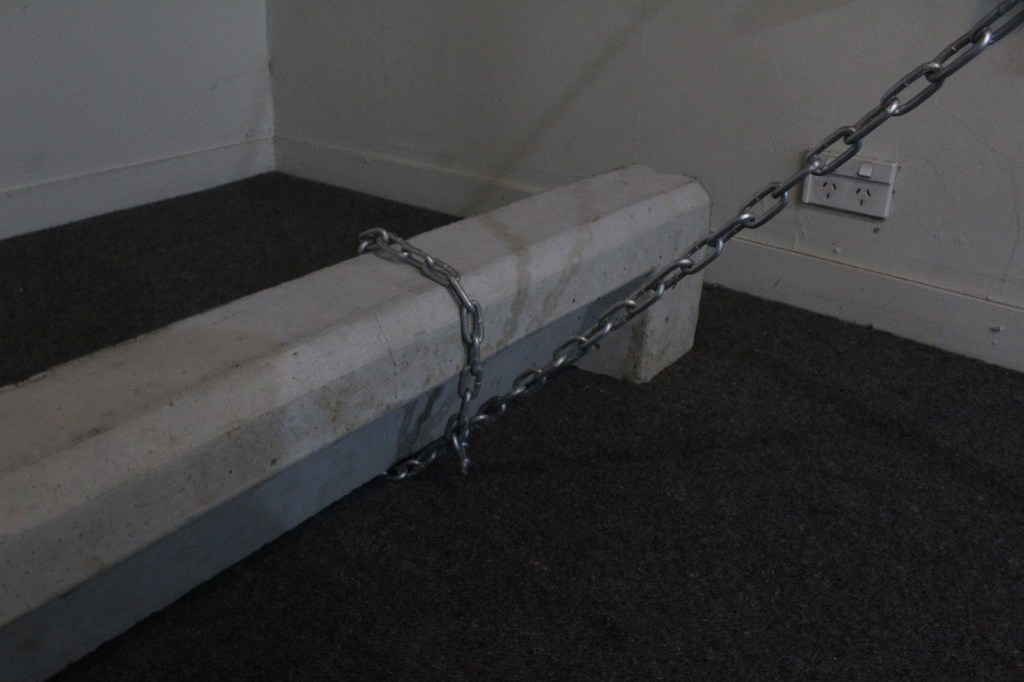
I had to come to turns with the reality of the weight and strain the centre object would have on the frame itself. A frame which is already extremely fragile and with enough force could snap rather easily. Completely stuck at this point, I had to wheedle my way through the problem if I wanted to complete this project at all. However, faced with a problem, I found a solution. If there were to be counter weights of each side of the frame it could support the stress of the object in the middle. Foraging through my collection of found materials, I picked the two heaviest concrete objects. A curb and a concrete pipe (Used in a prior project). Upon picking the objects. I had to create the holes in which four chains would be attached to in holding three separate objects. Two chains holding the centre object. One chain each for the two supporting weights. And so I drilled the holes every spaced from the top of the clothing racks frame. Experimenting with a new idea in the process, I removed the clothing rack pole (The pole in which we hang our clothes on), drilled some holes, attached a chain and connected it to the ceiling, leaving it suspended there. I felt that through researching artists which disrupt the typical conventions of architecture, I sought to attempt the same. Disassembling and restructuring.
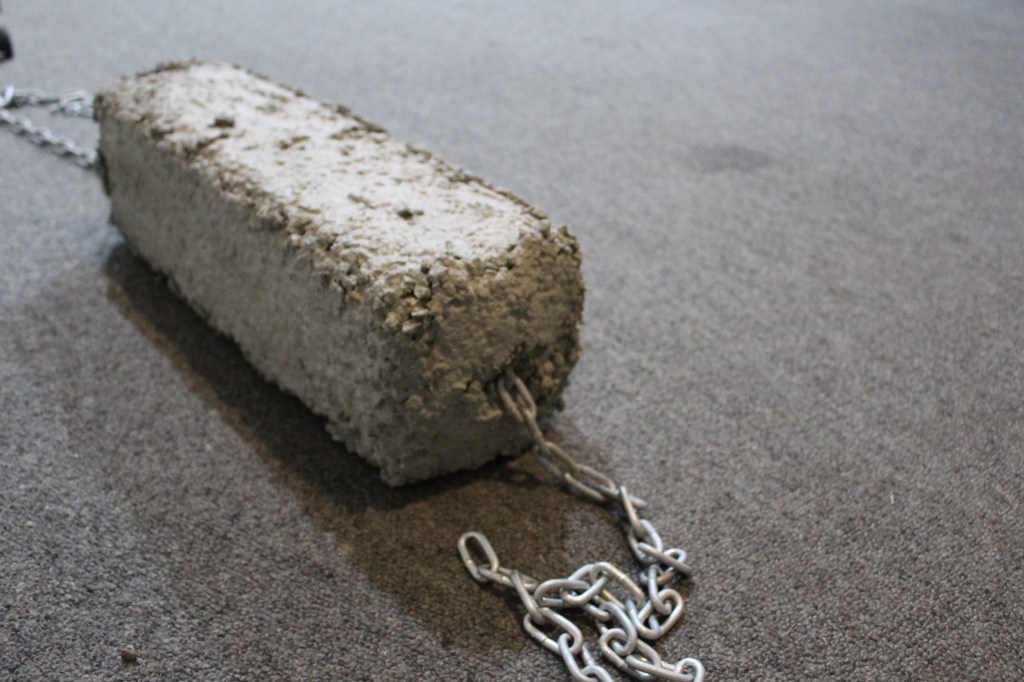

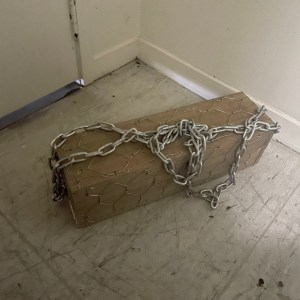
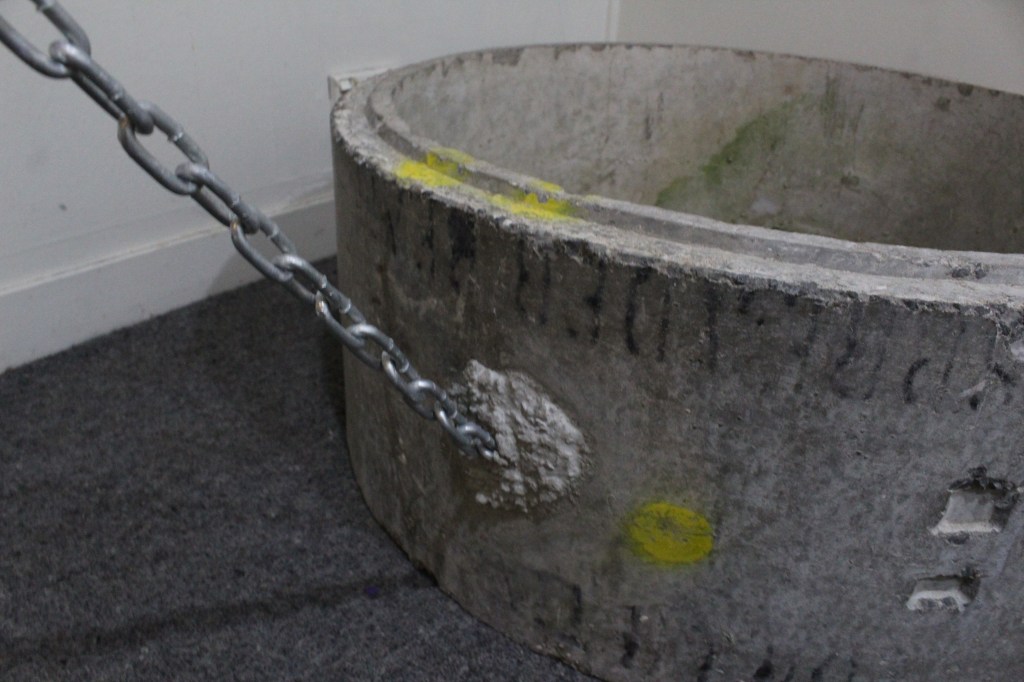
The next step in the process was to apply to cement to the appropriate objects that were in need of it. The first was that of the chicken wired layered wood. Using quick-set concrete I carefully mixed and applied the cement in thick enough layers to each side of the wood. The purpose of applying a slightly thicker than usually layer is to avoid cracking as the cement drys. A process in which the cement tends to shrink and crack. The most difficult part of this was the mixing however. To find the correct cement mixture to water ratio was a challenging task. Sometimes the mixture was too dry or too soupy. Although there is time pressure to apply before the mixture hardens, patience is key in making sure all is right. Upon applying cement to the wood, with the mixture I had left, it was time to attach the chain to the pipe. There was cavity in the pipes surface in which a small bolt was hidden. I wrapped the chain around the bolt and cable tied to links together at their intersection, making sure there was little to no movement. When content with the positioning, I filled the cavity with the cement mixture and waited for it too harden. The exposed chain was lifted up and shackled to the window sill above to avoid any unnecessary links setting in the concrete.
 Finn Olsen-Hennessy